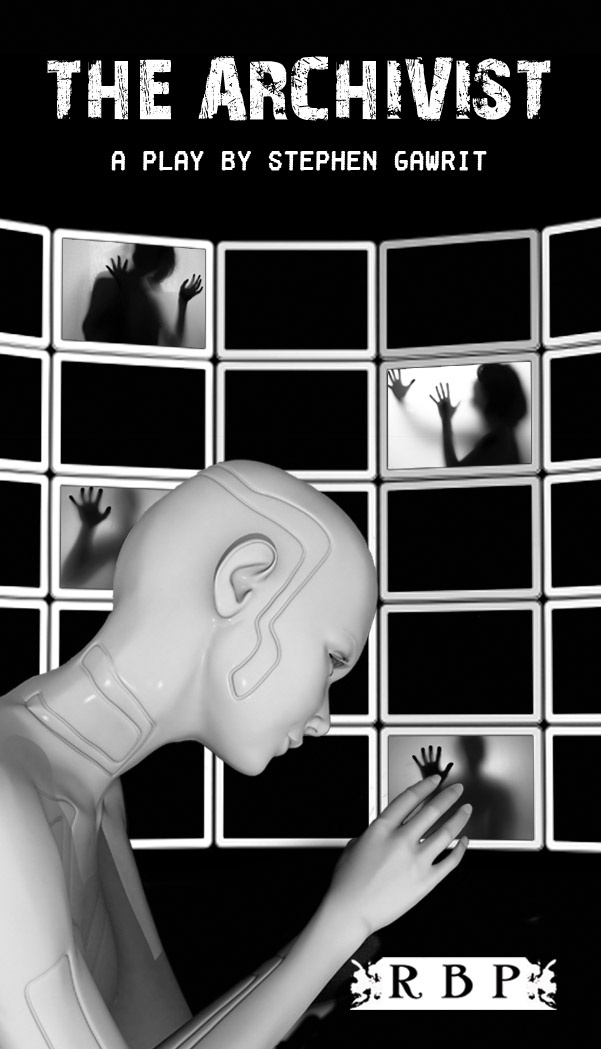
The Archivist takes place well into a future without humans, who have brought on their own self-destruction through nuclear war. Unfortunately this was the only unoriginal part of an incredibly original and fascinating future. Upon enter the RBP’s space, viewers are greeted with video showing the impending atomic holocaust (the footage seemed to be taken from Terminator 3: Rise of the Machines, but if I were to claim this as fact, I would be outing myself for having seen that film one too many times). The chorus of this futuristic tragedy doubles as Voices, or vessels for the thoughts of the plays characters (I think). This was probably the least effective part of the performance. The group’s delivery in unison and spoken rhythms will benefit from a few more performances.
In an effort to “chronicle and validate” humankind, a group of cyborgs known as Archivists or Creators, travel through time and space, recording human memories. This is where the play took off. The crop of cyborgs- a silent film actress, a father and his teenage daughter, and a solider return with a head-full of memories and a deep connection to the lives they lived in the past, a connection so strong that the line between reality and assignment ultimately disappears.
Colby Sellers and Charlotte Mae Jusino gave deeply moving performances as a suicidal teen and her broken father, who was left to watch the story of her demise play out on tabloid television. Natalie DiCristofano also shined as the copy of a manically depressed silent film star.
If you’re tracking a common mood here, it’s clearly sadness. Both the strengths and weaknesses of the play are rooted in Gawrit’s commitment to strong and excessive shades of the same gloomy color. The world resembled that of 12 Monkeys, where logic and sense clearly elude survivors in the future after a biological epidemic sends them underground. It also has hints of Kurt Vonnegut’s “Slapstick,” where the few survivors fail to fully adjust to their post-apocalyptic world that they had a hand in creating.
What is missing here that is present in both of those works is a sense of humor or satire. As a viewer (and apparent inhabitant of this world – a part of the performance that I never fully understood), you are left wishing for some context or perspective as a witness.
At the same time, much of the emotion and contemplation is only possible through the commitment of the performances and the play’s emotional message that seeps through in the final scenes between The last Archivist (Evan Hill) and his Companion/mate (Meghan Phillipp). Their final decision in the face of insurmountable obstacles to their own existence and mission is moving and hits themes deeper than most works I’ve experienced in the science fiction genre. There’s plenty of hopelessness here, as in many post-apocalyptic works, but the ending to the story of the central characters is inward and human. At the same time, efforts to physically integrate the audience into the world of the play end up detracting from the otherwise powerful climax.
Alexis Michael’s scenic design is fantastic, alluding to futuristic worlds we are all familiar with in popular post-apocalyptic sci-fi film, but seemingly unique to the world of this play at the same time. Beyond the unnecessary entrance into the space, the main scenic design was amazingly wrapped around and built into the tiny space of the RBP. Maybe 20 seats at most are available and while the acknowledgement of the audience was more distracting than anything else, the proximity to the action and the excellent navigation of the actors through the space added to the awesomeness of the experience.
Peterson should be commended for her work choreographing the actors as characters that experience multiple states of consciousness while they seamlessly work their way through the space. Rather than watching actors dodge one other, the set, and the audience, it was as if such cramped living conditions were all the characters knew.
While the play is utterly confusing at times (I am certain I have botched the story and the rules of this new world in my writing here) and the dark and saddened mood can be cumbersome without a variety of emotional undertones, “The Archivist” is more than worth it! Whatever it lacks in clarity and variety, it makes up for with depth and a wholly original future.
Be patient, drink water (it’s provided as the space gets pretty warm), and think while you watch. Gawrit’s unwavering commitment to the humanity of his characters, and the excellent collaboration of Peterson and Michael in building a fully operational model for this complex story make “The Archivist” well worth the trip.
Grade: A-
-Michael Dice, Jr.


